


Wall Sawing vs Hand Sawing: Picking the Right Cut for a Tight Site
The short answer
Pick wall sawing when the opening is long, deep and straight, and there’s room to anchor a track to the wall. Pick hand sawing for short, shallow cuts in tight spots where a track won’t fit.
Get it wrong, and the crew turns up with a wall saw for a stairwell it can’t fit into, or a hand saw for a structural doorway it can’t cut deep enough. Either way, the program stalls, and the trades booked in after the cut lose their slot.
20+
Years cutting concrete across Melbourne
1,000+
Residential, commercial and industrial projects
~300mm
Ring saw reach when a hand saw runs out of depth
Wall Sawing vs Hand Sawing at a Glance
Here’s how the two methods compare on the things that decide a tight-site job.
| Factor | Wall sawing | Hand sawing |
| How it’s guided | Track-mounted, anchored to the wall | Handheld, guided by the operator |
| Cut depth | Deep, matched to wall thickness, staged passes | Shallow; a ring saw reaches around 300mm |
| Space needed | Clear wall face and room for the track | Fits stairwells and confined spaces |
| Setup | Longer, as the track is anchored and checked | Quick |
| Straight line over a long cut | Very consistent | Harder to hold over length |
| Heavy reinforcement | Power and stability to keep cutting | Light reinforcement on small cuts only |
| Best for | Doorways, windows, lift shafts | Small openings, corners, detail work |
How Wall Sawing Works on a Track-Mounted Saw
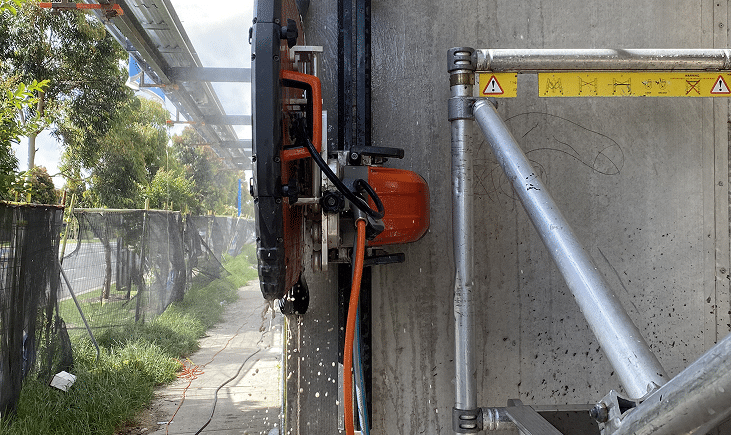
The track is the whole point. It gets anchored to the wall face, and the saw head runs along it with a diamond blade. Because the blade can’t wander, the cut stays dead straight through the full thickness of the wall.
Thick or heavily reinforced walls are cut in staged passes, going a bit deeper each time rather than forcing it all in one go. That keeps the blade cutting and the surrounding structure sound. Our wall sawing runs on Husqvarna saws and diamond blades, the kind of equipment tier-1 builders expect to see on site.
STEP 1
Anchor the track
The track is fixed to the wall face and checked against the marked line.
STEP 2
Cut in staged passes
The blade goes a bit deeper each pass until it’s through the full wall.
STEP 3
Finish the corners
Hand saw, ring saw or core drill squares off what the round blade can’t reach.
How Hand Sawing Works and Where It Fits
A hand saw is a powered, handheld cut-off saw with a diamond blade, guided by the operator rather than a track. There’s nothing to anchor, so it’s ready to go almost straight away.
It’s slower by design on precise work, and that’s the point when the margin for error is small. Hand sawing is built for:
- Small openings and adjustments
- Detail work and finishing cuts
- Tight corners and stairwells
- Confined spaces where a bigger rig won’t fit
Cut Depth: How Far Each Method Reaches
This is where the two methods split hardest. A wall saw is built for depth, matched to the wall’s thickness, reinforcement and construction on the day. A handheld saw is the shallowest tool on the truck. When a handheld cut needs more reach, a ring saw takes over.
Reach by saw type
Bars show relative reach, not exact depths. Actual depth depends on blade size, wall and access.
Hand saw
Ring saw
Wall saw
Access and Space: When a Track Won’t Fit
A wall saw needs a clear stretch of wall to anchor the track, plus room for the saw head and blade guard. In a narrow stairwell, a basement plant room crowded with pipes, or a wall sitting tight against a neighbouring structure, that space just isn’t there. That’s when hand sawing comes in.
Before you book: a two-minute access check
✓ Measure the clear space around the opening
✓ Note anything fixed to the wall: pipes, conduit, brackets
✓ Check for neighbouring walls or structures tight to the cut
✓ Send photos and tell your cutter up front if access is tight
Two minutes of work saves a wasted trip. A good contractor would rather plan for a hand saw and ring saw combination on day one than discover on the morning that the track won’t go up.
Precision and Finish on Structural Openings
On a structural doorway, the frame going in afterwards assumes the opening is square, plumb and the right size. Wall sawing gives you that over the full length of the cut. A handheld saw can be precise on a short cut, but holding a perfect line down a full-height doorway through a thick wall is hard work for any operator.
That’s why structural openings are usually wall sawn, with hand tools used to finish the detail. It’s also why a scope that just says “cut a doorway” isn’t enough. Your cutter needs to know:
- Whether the frame is steel, timber or aluminium
- What tolerance the frame needs
- How much finishing work the corners will take as a result
Corners and Overcuts: Where Hand and Ring Saws Finish the Job
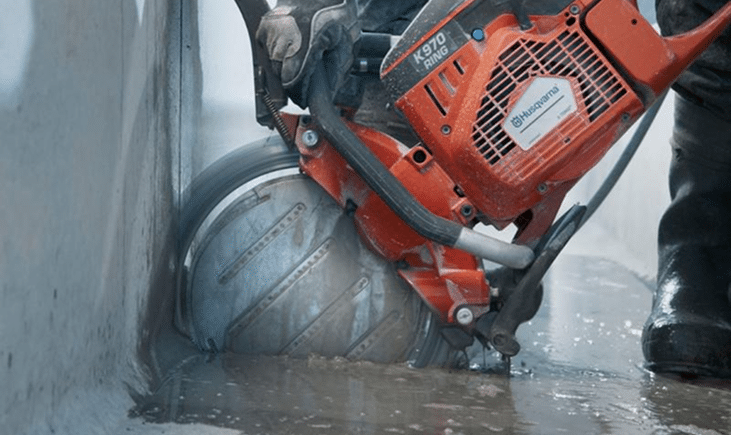
A round blade can’t cut into a square corner. Run it to the end of the line, and it either stops short at full depth, or runs past the corner and leaves an overcut. On a lot of structural openings, overcuts aren’t allowed.
Wall saw
Does the long, straight runs between the corners.
Hand or ring saw
Squares off what’s left at each corner.
Or core drill first
Where it suits better, the corners get cored before the saw runs.
Either way, the finished opening matches the line the rest of the cut set.
Reinforced Walls, Stairwells and Confined Spaces
| Site condition | Favours | Why |
| Heavily reinforced wall | Wall saw | Power and stability to cut through rebar without the blade glazing over |
| Light reinforcement, small cut | Hand saw | Manageable, but hard going on anything thick |
| Stairwell or confined space | Hand saw | Nothing else fits |
| Main opening plus tight spots | Both | Wall saw for the opening, hand saw for the bits it can’t reach |
⚠ Check what’s behind the wall
Older Melbourne walls often hide pipes, cables and vents that nobody marked on the plans. Before either saw starts on a structural section, reinforcement and hidden services need to be located, with scanning arranged where the job calls for it.
Dust, Noise and Water Control on a Tight or Occupied Site
Both methods release respirable crystalline silica, so wet cutting and dust extraction are standard on both saws.
0.05mg/m³
Respirable crystalline silica, 8-hour average
That’s WorkSafe Victoria’s exposure standard. In Victoria, high-risk crystalline silica work also needs a hazard control statement before it starts.
Wet cutting and dust extraction keep both saws inside the limit, and slurry is cleared before we leave.
On a tight site, a handheld saw puts the dust source right next to the operator, so water and extraction matter even more. Track-mounted sawing keeps vibration and dust well under control compared with breaking an opening out by hand.
On the job: Karingal Hub Shopping Centre
Structural wall openings were cut while the centre kept trading.
Setup Time Versus Cutting Time
It catches people out: the wall saw is slower to start but faster to finish. Anchoring and checking the track takes time, but once it’s running, a long, deep cut goes quickly and consistently. A hand saw starts in minutes but slows right down on long or deep cuts, and operator fatigue becomes a real factor.
Where the time goes on a long, deep cut
Illustrative only, not to scale. Real times depend on the wall, the opening and access.
Wall saw
Hand saw
So for one small vent opening, hand sawing usually wins. For a full doorway, the wall saw’s setup pays for itself.
Which Method Suits Doorways, Window Openings and Service Penetrations
| Opening | Best method | Notes |
| Doorways | Wall sawing | Corners finished by hand saw, ring saw or core drill |
| Window openings | Wall sawing for most | Hand sawing for small, shallow openings in tight spots |
| Service penetrations and vents | Core drilling or hand sawing | Core drilling for round holes, hand sawing for small square ones |
| Lift shafts | Wall sawing | Often paired with core drilling for the services |
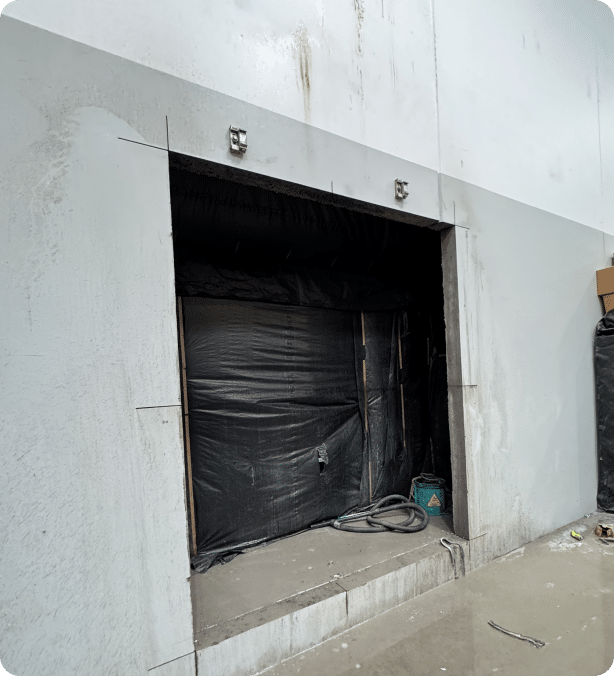
| Showroom and shopfront openings | Wall sawing | Like the structural wall opening our team cut for the BYD dealership fit-out in Kew |
Education, live site
Lowther Hall Anglican Grammar School
Lift shaft openings, wall sawing and core drilling.
Retail, trading
Karingal Hub Shopping Centre
Structural wall openings in a trading centre.
Automotive, fit-out
BYD Dealership, Kew
Structural wall opening for the showroom.
How to Brief a Concrete Cutter So the Right Saw Turns Up
1
Measure it
Opening size, wall thickness, and wall type, whether concrete, brick or block.
2
Show the space
Photos of the opening and the clear space around it, plus anything fixed to the wall.
3
Flag the risk
Is it structural, is the site occupied, and are there engineering drawings?
⚠ Structural openings
If the opening is structural, the engineer’s design comes first. Cutting into a load-bearing wall that needs temporary propping counts as high-risk construction work, so a SWMS is required. Your building surveyor can confirm whether permits are needed.
Frequently Asked Questions About Wall and Hand Sawing
Can a hand saw cut a full doorway?+
On a thin, light wall, sometimes. On a thick or reinforced structural wall, a wall saw is the right tool.
Why do wall-sawn openings need their corners finished?+
Because a round blade can’t cut a square corner without overcutting it. A hand saw, ring saw or core drill finishes each corner.
Is a ring saw the same as a hand saw?+
Both are handheld, but a ring saw drives the blade from its outer edge rather than a centre shaft, so it cuts deeper for its size. That’s why it takes over when a hand saw runs out of reach.
Which is faster, wall sawing or hand sawing?+
It depends on the cut. A hand saw starts faster, so it usually wins on one small opening. A wall saw takes longer to set up but cuts long, deep runs quickly, so it wins on a full doorway.
Can you cut wall openings on an occupied or trading site?+
Yes. Wet cutting and dust extraction keep silica under control, and the work gets scheduled around the site. Structural wall openings at Karingal Hub Shopping Centre were cut while the centre kept trading.
Do I need an engineer for a new opening?+
For anything in a load-bearing wall, yes. For a small opening in a non-structural partition, usually not, but check if you’re unsure.
Book a Free, Site-Assessed Quote
Not sure whether your opening needs a track or a hand saw? Send a few photos and the wall thickness, and we’ll tell you which saw is coming and why before anything gets booked. We walk every site before quoting, so the price is based on your actual wall, not a guess.
Get a free, real quote for your wall opening
Over 20 years cutting concrete around Melbourne. Fully licensed, insured and WorkSafe compliant.