


Core Drilling and Coring Melbourne
What Is Core Drilling And Coring
Core drilling and coring mean cutting an accurate, round hole through concrete, brick, or masonry with a diamond-tipped, water-cooled core bit, most often for a pipe, a conduit, or a service run that has to pass straight through a concrete slab or wall. Melbourne slabs carry more than load, post-tensioned cables, ageing conduit, and service penetrations nobody documented, so core drilling without knowing what is in the concrete slab can turn a half-day installation work into a structural callback.
Melbourne Concrete Cutters has run core drilling and coring services across Melbourne for 20+ years, with 1,000+ residential, commercial, and industrial projects completed, fully licensed, and WorkSafe Victoria compliant on every hole.
Core drilling rarely happens without a straight quote setting the terms first. That quote should confirm the concrete type, slab depth, and access, so the crew arrives ready to cut rather than working it out on site. Builders running several projects at once find it simpler to contact the crew once for all the services needed than chase a fresh quote for every job.
Core drilling rarely stands alone on a live site. The same crew might have used a wall saw to open access, cleared a section with a road saw, or brought in a ring saw where a straight saw can’t reach thick concrete. That mix of wall, road, and ring work — cutting, sawing, and coring under one professional crew — means one contact covers all the services: wall cutting, road sawing, and ring jobs, the same rig used across all three.
Every cored hole gets used for something exact: a pipe, a cable, a drain, and a professional approach checks behind the concrete before the bit goes in, not after a cut goes wrong. For projects with a tight program, one professional crew covering cutting, sawing, and services from the first cut to the final core keeps things moving, and confirming the quote early means the next projects don’t wait on a second contact.
Plumbing, Electrical, and HVAC Penetrations
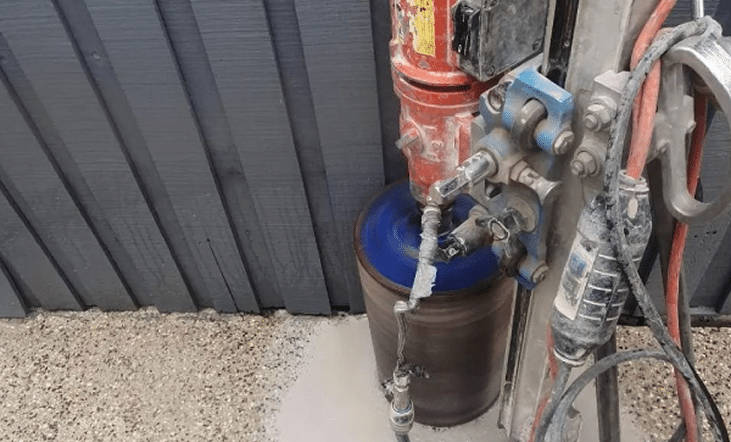
Core holes for plumbing, electrical, and HVAC runs are the daily bread of this trade. Diameter and depth have to match the install exactly, whether that is a 100mm hole through a reinforced slab for a waste pipe, or a data conduit run through a commercial wall. Scanning before drilling is standard here, not an upsell.
A drain riser, a network cable, and a return-air duct rarely want the same size hole. Wider commercial runs often need ring cutting first to open access, and that same professional-grade ring saw handles tight radius work a straight saw can’t reach. Sawing ahead of drilling protects the surrounding concrete, and that sawing step matters as much on a small domestic penetration as a slab poured with reinforced concrete.
Every trade treats that hole as a different service: the concrete used around a plumbing run needs a different seal to the concrete used for an electrical conduit, and the same saw isn’t always used twice in a row. One professional service covers the cutting, the sawing, the ring work and the core cutting, so a builder isn’t juggling separate services or a fresh contact for every trade. That professional operator keeps a single contact and one service for the whole job, covering core and cutting services across the site, and only follows up again with a second contact if the trade list or the services required change mid-program.
Hand-Held Core Drilling For Tight Access
Plant rooms, basement walls and overhead angles do not always give a rig room to set up. Hand-held core drilling covers that tight access, holding position and precision without needing the footprint a larger rig demands.
A confined plant room or basement changes how the crew manages water more than it changes the hole itself. Every drop used to cool the bit through solid concrete has to be captured on the spot, not left pooling near live plant or wiring, so containment goes up before drilling starts. That same care carries into any sawing done alongside it, sawing a section back to fit the rig, then sawing the edge square once the core is through.
Overhead angles add their own concrete problem: slurry falls rather than runs, so containment sits above the hole as much as below it. Hand-held sawing and coring suit this kind of access precisely because the rig goes where a floor saw can’t, tight risers, low soffits, awkward concrete corners, without dragging slurry lines across a live site.
Hydraulic Core Drilling For Large Diameter Holes
Large-diameter penetrations, storm drainage shafts, mechanical risers, openings above 300 mm need a rig with the mass to hold position under load. Hydraulic core drilling delivers that stability on the bigger holes a hand-held drill cannot manage cleanly.
A 300mm-plus core through thick concrete comes out as a solid cylindrical mass, often over 50kg — lifting gear and a clear drop zone get planned before the rig even starts.
Pulling the plug out is its own job on a bore this size. A 300mm-plus core through thick concrete comes out as a solid cylindrical mass, often over 50kg, so lifting gear and a clear drop zone get planned before the rig even starts, not after the core lets go. Leaving that weight of concrete to fall free onto a mechanical riser or drainage shaft below risks damage the hole was never meant to cause.
Water volume scales with the bore too. Cooling a bit through that much concrete needs a steady, higher-flow supply than a small penetration, so containment and drainage get set up to match, keeping slurry off any finished surface nearby on a live site.
Scanning Before Every Core Hole
Post-tensioned cables are the risk most jobs do not account for until something goes wrong. Anything poured between the late 1970s and mid-1990s carries a real probability of post-tensioned elements, and residential suspended slabs, transfer slabs, basement walls, and multi-storey commercial floors all carry the same principle: scan first, drill second.
A scan takes minutes; unwinding a severed cable takes days and a structural engineer’s sign-off before work resumes. That gap alone is why the scan happens on every job, not just the ones that look risky on paper. A slab’s finish or age tells a crew nothing about what’s cast inside the concrete; only a GPR sweep does.
Marking up the concrete after scanning matters as much as the scan itself, chalked lines showing safe zones so the person running the drill isn’t relying on memory once dust starts flying. On a shared site, that marked-up concrete also tells other trades where not to anchor or fix into the same section later, extending the value of one scan well past the single hole it was done for.
Core Hole Sizes And Depths We Handle
| Detail | Range |
|---|---|
| Hole diameter | 25mm to 750mm |
| Standard single-pass depth | 300-400mm |
| Extended depth | Achievable with barrel extensions |
| Rebar | Standard reinforcing steel cut through without halting the job |
Fire Service And Structural Penetrations
Fire service installations under AS 1851 do not allow field adjustments, so the hole has to be right the first time. Structural penetrations through transfer slabs, basement walls and load-bearing elements get the same scan-first approach applied to every other core drilling job.
A building certifier walking a fire inspection wants to see the penetration before the ceiling closes over it, which puts real-time pressure on when this concrete job happens in the build sequence. Cutting through concrete too late, after linings are up, means opening a finished wall just to prove compliance.
Structural penetrations carry a different pressure entirely, load rather than certification. Removing a section of concrete from a transfer slab changes how that slab carries weight above it, if only locally, so position matters as much as diameter. Getting both jobs done in the right order on a live site — fire penetrations while services are still exposed, structural cores once the engineer has cleared the spot — keeps a crew from cutting the same section of concrete twice.
Core Drilling On Commercial And Industrial Sites
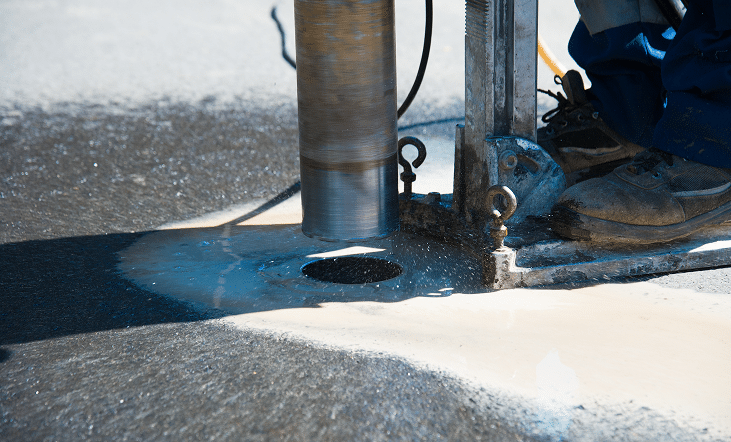
Commercial coring means working around a live building, a trading centre, or an occupied fit-out, with dust and noise managed so business keeps running. Industrial coring often means older concrete slabs, decades-old pours where drawings are incomplete or missing altogether, and the risk of hitting something undocumented is highest.
Commercial
Dust extraction and vacuum shrouding keep coring contained near a trading floor or occupied office; noise scheduled around business hours.
Industrial
Decades-old pours, incomplete drawings, and carbonation-hardened concrete that drills differently metre to metre.
Older industrial concrete isn’t just harder to document; it drills differently. Decades of carbonation and aggregate variation can leave one section of concrete far harder than a metre away, so bit speed gets adjusted through the cut rather than set once and left. A rig running blind through concrete like that risks a stalled bit or a rough exit on the underside.
Commercial sites bring the opposite challenge, less about the concrete and more about who’s standing near it. Dust extraction and vacuum shrouding keep a coring job contained near a trading floor or occupied office, and noise scheduled around business hours matters as much as containment. Reading old concrete on an industrial job and containing a fresh cut on a commercial one are different skills, and getting both right is what keeps either site running without a shutdown down the road.
Our Core Drilling Process
Site Scan
Check for cables, conduit and embedded services first.
Rig Setup
Hand-held or hydraulic, matched to hole size and access.
Drill & Sign-Off
Wet drilling, slurry cleared, hole signed off ready.
1. Site Scan Before The Drill Rig Arrives
Every core job starts with a check for post-tensioned cables, conduit, and embedded services before any equipment goes in.
2. Rig Setup Matched To Access And Diameter
Hand-held or hydraulic, the rig gets matched to the hole size and the space available on site.
3. Wet Diamond Core Drilling With Slurry Control, Then Sign-Off
Water-cooled drilling controls dust, slurry gets cleared, and the core hole gets signed off ready for the next trade.
That sign-off isn’t paperwork for its own sake. It’s the record a facilities manager can point to later, proof a hole through concrete was checked, drilled and cleared to spec, not just cut and left. Across a portfolio with several buildings, the same three-step process running identically at every site means concrete service at one property gets the same scrutiny as concrete service at another, whichever crew turns up.
Other trades rely on that record more than they realise. A plumber or electrician working off yesterday’s sign-off shouldn’t need to double-check what’s behind the slab themselves; the record already confirms what the concrete was hiding and what’s now clear to run through.
How Much Does Core Drilling Cost In Melbourne
A standard residential penetration typically runs $150 to $350, while commercial work is priced on diameter, depth, slab type and access rather than a flat rate. A single domestic core through a 150mm slab takes under an hour once the rig is positioned, and most Melbourne jobs wrap within a half-day.
Commercial work is priced on diameter, depth, slab type and access rather than a flat rate — most Melbourne jobs wrap within a half-day.
Same Day Core Drilling Quotes
A drain needing a core hole before an inspection, or a service that has to go in before the next trade arrives, both come up regularly. Same-day quotes and confirmed arrival times mean other trades are not left waiting on a decision that could have been made that morning.
Core Drilling Versus Concrete Cutting: How To Choose
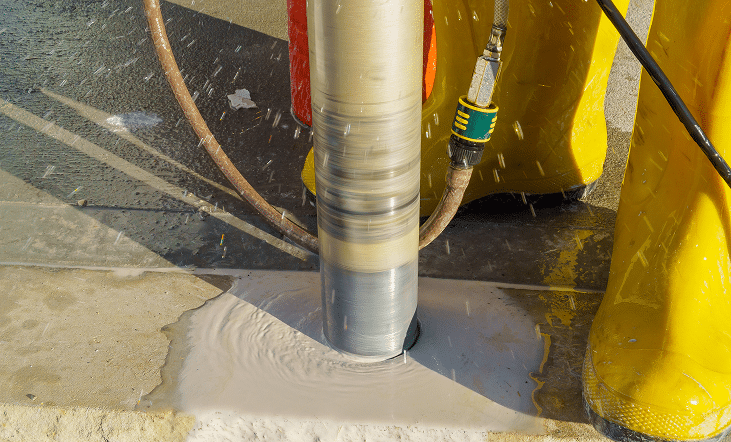
Core drilling is the right call for round, service-sized penetrations, plumbing, electrical, HVAC. Concrete cutting (sawing) is the right call for straight lines, openings and larger structural work. Most Melbourne jobs use a mix of both, and the site assessment is where that gets decided, not guessed.
| Core Drilling | Concrete Cutting (Sawing) |
|---|---|
| Round, service-sized penetrations | Straight lines and openings |
| Plumbing, electrical, HVAC runs | Doorways, windows, lift shafts |
| 25mm–750mm diameter | Larger structural work |
| Best for a single service pass-through | Best for demolition and removal prep |
Core Drilling Questions From Melbourne Sites
How much does core drilling cost in Melbourne?
A standard residential penetration typically runs $150 to $350. Commercial work is priced on diameter, depth, slab type and access rather than a flat rate.
What size core holes can you drill?
From 25mm to 750mm diameter, with a standard single-pass depth of 300-400mm. Extended depth is achievable with barrel extensions.
Do you scan before every core hole?
Yes. Anything poured between the late 1970s and mid-1990s carries a real probability of post-tensioned elements, so scanning happens before every relevant job, not just the ones that look risky on paper.
How do I know if I need core drilling or concrete cutting?
Core drilling suits round, service-sized penetrations like plumbing, electrical and HVAC. Concrete cutting suits straight lines, openings and larger structural work. Most jobs use a mix of both — the site assessment decides.
Get A Core Drilling Quote
Send through the site details, hole size, depth and access, and get a straight core drilling quote for anywhere across Melbourne.