


Concrete Sawing Melbourne
What Is Concrete Sawing
Concrete sawing is the process of cutting through concrete, brick, or asphalt with a diamond-tipped blade, and in Melbourne it is rarely one job; it is whichever combination of road sawing, wall sawing, hand sawing, and ring sawing the site actually needs. Melbourne Site Manager Mike does not need a lecture on what sawing is; he needs a crew that turns up when booked, scans before it cuts, and does not hold up the next trade.
Melbourne Concrete Cutters has run concrete sawing jobs across the city for 20+ years, on 1,000+ residential, commercial, and industrial projects, fully licensed, insured, and WorkSafe compliant.
Core drilling rounds out road sawing, wall sawing, hand sawing, and ring sawing on a site like Mike’s. A core reaches where a saw cut can’t, and matching the core to the install keeps drilling accurate first time. It’s one more service on the list, not a separate call-out, a service Melbourne sites book as often as a straight cut.
Wet cutting leaves slurry behind, and a vacuum running with the saw lifts that slurry as the cutting happens. That same vacuum covers drilling too, so a core hole never trades a clean floor for slurry.
Melbourne Concrete Cutters runs every service to one professional standard, whether that’s a single core hole or a cutting programme across several projects. Services scale without disrupting work already booked, and the professional finish holds across every project. Time to scope, time to book, time on site, all inside the window the work allows.
Contact our team early, and stay in contact as concrete projects run, because every enquiry gets a straight answer through the same point of contact, whatever services are needed.
Road Saw Cutting For Driveways And Carriageways

Road sawing uses a track-mounted saw to cut driveways, slabs and full carriageways to depth. On a road job, a traffic management plan comes first; skip it, and the job stalls before the blade even starts. This is the sawing service behind civil and council work across Melbourne, where an inspector checks the result before the road reopens.
Drilling for service conduits under a carriageway is separate from cutting the concrete surface itself, though both often happen on the same visit. Concrete carriageways handle the saw differently to driveway slabs, so cutting depth, slurry volume, and vacuum capacity all shift lane by lane.
A vacuum sized for that load keeps slurry off the concrete surface before inspection, and the same vacuum unit clears drilling debris just as fast. Melbourne Concrete Cutters runs cutting, drilling, and every other concrete service as one professional operation, not a string of separate services.
That professional crew keeps one contact across council and civil projects, scoping timing, services, and sign-off together. A slurry vacuum rides on every truck as standard, backing that same professional service across carriageway projects council books. Contact us early, and those services stay booked through that same contact as concrete cutting projects repeat.
Wall Sawing For Structural Openings
Wall sawing opens structural walls for doorways, windows, lift shafts, and services. Behind an older Melbourne wall there is usually a pipe, a cable, or a vent nobody marked on the plans, so wall sawing works around what is actually there on site, not what the drawings claim. This is the service behind flagship jobs at Lowther Hall Anglican Grammar School, Karingal Hub Shopping Centre, and the BYD Kew showroom fit-out, all live or trading sites at the time of concrete cutting.
A lift shaft opening asks more of drilling than a simple doorway does: extra anchor points, extra services checks before the saw runs continuously. Each opening type carries its own risk, so lift shafts, windows and doorways are all scoped for their own drilling and services rather than one blanket method.
Indoor slurry behaves differently to an outdoor cut. Carpet, tile, and reception floors soak up slurry fast, so a vacuum stays on the blade the whole pass, not just at the end. Concrete dust from a dry section receives the same vacuum treatment, keeping air clear in trading spaces around the opening.
Melbourne Concrete Cutters coordinates services, drilling and vacuum containment as one sequence for every structural concrete opening, sized to whichever wall or floor it runs through.
Hand Sawing For Tight Spaces
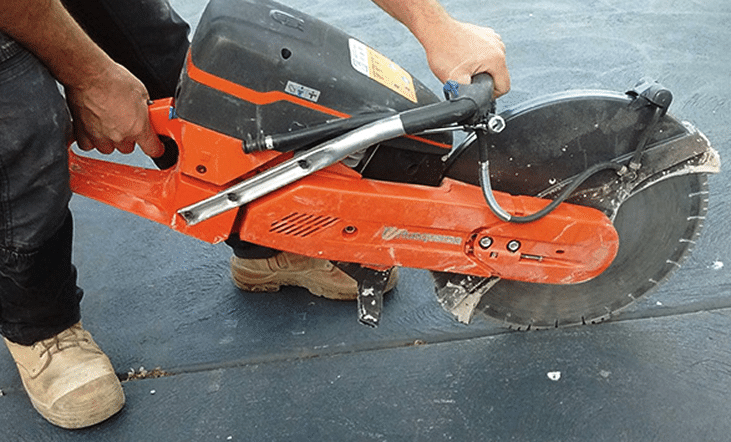
For tight corners, stairwells, and spots a bigger rig cannot reach, hand sawing gets the precision a track saw cannot manage in confined spaces. It is slower by design, and that is the point on a job where the margin for error is small.
A hand saw finishes what bigger gear starts and stops short of. Where a track saw leaves a rounded corner because the blade can’t pivot tight enough, hand sawing squares off that last stretch of concrete cleanly, matching the line the rest of the cut already set.
It also suits spot work, a single step, a narrow riser, a section of concrete flagged for repair rather than a full opening. Operator control counts for more than blade size here, since a hand saw follows the exact shape needed rather than the shape a bigger rig is built for.
Melbourne Concrete Cutters keeps a hand saw on every crew for that reason, so no concrete edge gets left rough just because the space around it was too tight for anything larger.
Ring Sawing For Deep, Awkward Cuts
Ring saw cutting reaches deep, awkward cuts other equipment cannot touch: pipes set into a slab, tight openings near a wall, anywhere access is worse than depth. It handles cuts up to around 300mm where a floor saw simply cannot get in.
Depth is where ring sawing draws its line, useful up to around 300mm but not built to go further, so cutting past that point calls for wire sawing instead. Knowing that ceiling upfront saves picking the wrong saw for a deep pipe or duct run.
Services running close to a slab edge often dictate the approach too, since a ring saw’s reach lets it work tight to a pipe without the swing space a floor saw needs. Concrete near an existing patch or an odd angle takes that same reach well.
Melbourne Concrete Cutters treats ring sawing as the answer once depth and access rule other concrete cutting methods out, matched to concrete and services that a straighter approach can’t handle.
Concrete Sawing Equipment We Use
Industry-grade diamond equipment does the work here: Husqvarna saws and diamond core rigs, kept consistent across every job type. Blade choice, water feed, and dust extraction all get matched to the slab, not run on a one-size-fits-all setting.
| Cutting Type | Typical Depth |
|---|---|
| Track-mounted floor saw | 150-200mm |
| Ring saw | Up to ~300mm |
| Wire saw | Unlimited, for major or civil work |
| Diamond core rig | As deep as the hole requires |
Suction gets matched to the equipment just as tightly as blades do. A vacuum built for a floor saw’s slower pass chokes on a ring saw’s finer dust, so each rig on the list runs its own vacuum setting rather than one shared unit.
Core rigs need less airflow than a full saw, so that vacuum stays smaller and closer to the bit, catching debris right where the hole forms. Matching vacuum output to depth and cutting type is what keeps the numbers in the table above holding true on site, not just on paper.
Wet Sawing And Dust Control On Site
Wet cutting and dust extraction keep WorkSafe Victoria’s silica exposure limit of 0.05mg/m3 in check on every job. Dry cutting works on small isolated cuts, but wet cutting is standard on any real-scale sawing job, and it is non-negotiable on a live, occupied site where dust complaints follow fast if it is skipped.
WorkSafe Victoria construction limit: without water suppression or dust extraction on a live site, this threshold gets breached early in the job — wet cutting is standard on any real-scale sawing job.
Water volume differs by task, and matching it right keeps both drilling and cutting compliant without flooding a finished area. A core drill needs a steady trickle at the bit, while a full slab cut through concrete demands a higher flow to suppress dust across the whole blade path.
Mains access isn’t guaranteed on every site, so tank supply gets planned in advance for drilling and cutting alike, sized to the concrete volume expected that day. Getting that water budget wrong on either task risks a dry patch mid-cut, exactly the gap the silica limit exists to prevent.
Concrete Sawing On Commercial And Industrial Sites

Commercial concrete sawing means working around other trades and a program that will not move: cuts get planned to fit the schedule, not disrupt it. Industrial jobs bring their own complications: warehouse conversions, plant upgrades, slabs poured decades before current standards existed, often around live operations that cannot simply stop for a saw.
Commercial
Cuts planned around other trades and a program that won’t move.
Industrial
Warehouse conversions, plant upgrades, decades-old slabs, live operations.
How Much Does Concrete Sawing Cost In Melbourne
Pricing centres on saw type, slab thickness, reinforcement and site access, with slurry management adding to the cost on certain jobs. A domestic saw cut through a 100mm slab and a commercial cut through a 300mm reinforced floor are not priced anywhere near each other, so a site-assessed quote beats a phone estimate every time.
Saw Type
Track, wall, hand, ring or core rig.
Slab Thickness
100mm domestic to 300mm+ reinforced.
Reinforcement
Rebar and mesh change the cutting plan.
Site Access
Plus slurry management on certain jobs.
Preparing Your Site For A Concrete Sawing Job
Site Assessment
Access, slab thickness and anything drawings missed.
Quote & Scheduling
Diameter, depth and access confirmed, arrival time holds.
Cutting & Clean-Up
Wet sawing, slurry cleared before the crew leaves.
1. Site Assessment
Every site gets walked before quoting, checking access, slab thickness, and anything the drawings missed.
2. Quote & Scheduling
Diameter, depth, and access get confirmed first, then a real quote goes out, not a placeholder figure, with an arrival time that holds.
3. Cutting And Clean-Up
Wet sawing keeps dust under control, and slurry gets cleared before the crew leaves, so the next trade is not held up by the mess.
Concrete Sawing Safety And WorkSafe Compliance
Every job runs fully licensed, insured and WorkSafe Victoria compliant, with full public liability cover as standard. Non-destructive scanning happens before every relevant cut, especially on slabs poured between the late 1970s and mid-1990s, where post-tensioned cables carry real risk if a saw goes in blind.
Concrete Sawing Questions From Melbourne Sites
What’s the difference between concrete sawing and concrete cutting?
Sawing specifically means a diamond-tipped blade cutting through concrete, brick or asphalt — road sawing, wall sawing, hand sawing and ring sawing are all sawing methods. Coring and demolition sit alongside sawing as related but distinct services.
How deep can a concrete saw cut?
Depends on the equipment. A track-mounted floor saw typically reaches 150-200mm, a ring saw up to around 300mm, and a wire saw has no practical depth limit for major or civil work.
Is wet sawing always required?
Dry cutting works on small isolated cuts, but wet cutting is standard on any real-scale job to keep WorkSafe Victoria’s 0.05mg/m³ silica exposure limit in check.
Do you scan before every cut?
Non-destructive scanning happens before every relevant cut, especially on slabs poured between the late 1970s and mid-1990s where post-tensioned cables carry real risk.
Booking A Concrete Sawing Quote
Whatever the sawing job, from a single control joint to a full commercial floor cut, the same process applies: send through the site details, access, depth, and what needs cutting, and get back a real quote for concrete sawing across Melbourne.